There are places in the world that assault your senses in the best possible way. Marrakech is one of them. From the moment you step into the medina, your eyes, nose, ears, and taste buds are engaged in a symphony of stimulation that no photograph or travel blog — including this one — can truly capture.
I came to Marrakech on a whim. A friend had canceled a trip, leaving me with a non-refundable riad booking and five days I hadn’t planned for. Sometimes the best journeys are the ones that begin without a plan. Within an hour of landing, I was lost in the souks, which, as it turns out, is exactly where you want to be.
Into the Medina
The medina of Marrakech is a labyrinth. Not metaphorically — it is an actual, UNESCO-listed maze of narrow alleys, covered passages, and dead ends that has been confounding visitors since the 11th century. Maps are useless here. GPS signals bounce between terracotta walls and give up somewhere around the third left turn. The only reliable navigation method is following your nose.
The spice merchants sit at the heart of this maze, their stalls arranged in clusters that date back generations. Some families have occupied the same corner for three or four hundred years. The stalls are small — rarely larger than a closet — but what they contain is extraordinary. Pyramids of cumin, turmeric, saffron, paprika, ras el hanout, and dozens of blends I’d never encountered before, each sculpted into perfect cones that seem to defy gravity.
Mohamed, a third-generation spice merchant I befriended on my second day, explained that the pyramid shape isn’t just for show. “The cone lets customers see the color and smell the aroma from a distance,” he told me, adjusting a tower of golden turmeric with practiced hands. “My grandfather taught me the shape. His grandfather taught him. We don’t use scoops — we shape by hand. Every pyramid is a signature.”
The colors alone would make an artist weep. Saffron threads glowing like threads of sunset. Deep crimson paprika beside bright yellow turmeric. Green dried herbs next to black cumin seeds. The visual impact is staggering, but it’s the smell that truly overwhelms. Each stall has its own fragrant cloud — a warm, complex perfume that changes every few steps as you walk through the souk.
The Art of Ras El Hanout
If there’s one spice blend that defines Moroccan cuisine, it’s ras el hanout — literally “head of the shop,” meaning the best blend the merchant has to offer. Every family has their own recipe, passed down through generations and guarded like state secrets. Some blends contain fifteen ingredients. Others, fifty. I tasted one that Mohamed claimed had seventy-two.
The base usually includes cinnamon, cardamom, clove, cumin, coriander, and black pepper. But it’s the secondary ingredients that make each blend unique — dried rosebuds, lavender, long pepper, grains of paradise, ash berries, monk’s pepper, and ingredients whose names don’t translate into English. Mohamed let me smell each component individually before combining them in a brass mortar. The transformation was magical — separate ingredients that were pleasant but unremarkable suddenly created something complex, warm, and entirely new.
In Morocco, food isn’t just sustenance. It’s history, identity, and hospitality compressed into every meal. To share a tagine is to share a piece of your family’s story. – Sofia Martins
I bought three custom blends and a bag of saffron that cost more per gram than gold. Worth every dirham. Back home, a single pinch transports me across continents — the smell alone rebuilds the entire medina around me.
Eating Your Way Through the Souks
Street food in Marrakech is not for the faint-hearted, but it is for the hungry and the curious. Jemaa el-Fnaa, the famous main square, transforms every evening into the largest open-air restaurant in Africa. Smoke rises from hundreds of grills, vendors shout their menus into the crowd, and the whole place vibrates with energy that feels ancient and contemporary at once.
- Snail soup (babbouch) — served from steaming cauldrons, this is the ultimate Moroccan comfort food. The broth is flavored with thyme, pepper, licorice root, and a dozen herbs. Locals drink it like medicine in winter and like ritual year-round. The first spoonful is challenging. The second is addictive.
- Lamb mechoui — slow-roasted for eight hours in underground clay ovens until the meat falls apart at the touch. Served with cumin salt and fresh bread, it’s the simplest and most perfect meal I ate in Morocco.
- Msemen — flaky, buttery flatbread cooked on griddles and filled with honey or cheese. Street vendors make them to order, stretching the dough paper-thin before folding it into layers. The technique is mesmerizing to watch.
- Fresh orange juice — Marrakech runs on it. Every corner of the medina has a juice vendor with a pyramid of oranges and a hand press. A glass costs about 4 dirhams (roughly 40 cents) and tastes like concentrated sunshine.
- Pastilla — a traditional pie that combines shredded pigeon or chicken with almonds, cinnamon, and powdered sugar in crispy warqa pastry. Sweet and savory in perfect balance, it represents everything that’s beautiful about Moroccan cuisine.

Beyond the Market: Cooking with Fatima
The true education came on my third day, when Mohamed’s wife Fatima invited me to cook in their home. Moroccan hospitality doesn’t have an off switch — once you’re invited, you’re family. Fatima’s kitchen was small, centered around a gas burner and a collection of tagine pots that she’d inherited from her mother-in-law.
We shopped together in the morning. Fatima moved through the souk like a general — inspecting vegetables with surgical precision, rejecting three tomato vendors before finding one that met her standards, haggling with a smile that somehow made the fishmonger lower his price while thanking her for the privilege.
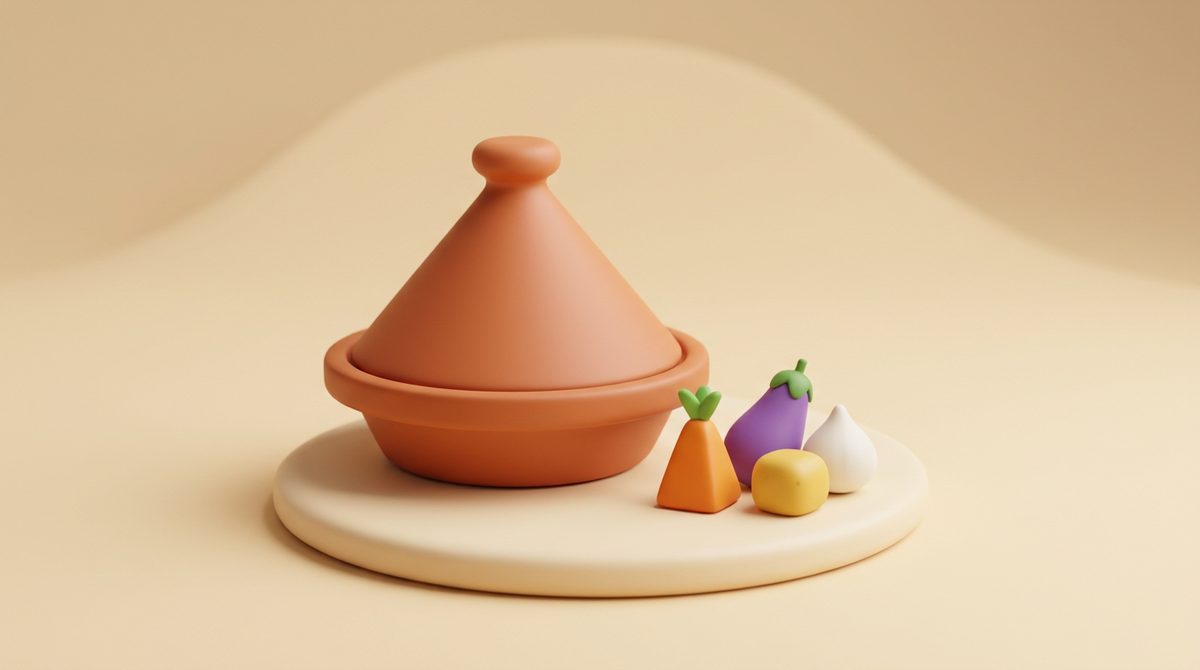
The tagine we made that afternoon — chicken with preserved lemons, olives, and saffron — took four hours. Fatima explained that Moroccan cooking is about patience and layering flavors. “You build a tagine like you build a house,” she said. “The foundation must be strong. Onions and spices first, always. Then you add, layer by layer, and let the fire do its work. No rushing. The tagine knows when it’s ready.”
The meal itself was served on the rooftop terrace, with Marrakech sprawling below us in the golden light of late afternoon. Mohamed, Fatima, their three children, a neighbor, and me — sharing bread, scooping from a communal tagine, drinking mint tea that Fatima sweetened with an almost alarming amount of sugar. It was the best meal of my life, not because of the food, but because of everything that surrounded it.
The Rhythm of the Medina
Marrakech operates on its own clock. The morning call to prayer from the Koutoubia Mosque reaches every corner of the medina before dawn. The souks open slowly, metal shutters rolling up one by one around 9 AM. The heat of midday empties the streets — everyone retreats to the cool interiors of riads and cafés. Then, around 4 PM, the city wakes again, and the real energy of Marrakech ignites.
I learned to match this rhythm. Early mornings for photography and exploring quiet streets. Midday for reading in the riad courtyard, listening to the fountain and the birds. Late afternoons for the souks and the square. Evenings for getting deliberately, wonderfully, hopelessly lost.
The spice markets taught me something I didn’t expect: that smell is the strongest trigger of memory. I’ve traveled to dozens of countries, but no place lives as vividly in my memory as those narrow alleys filled with the perfume of a thousand spices. All it takes is a whiff of cumin on a winter evening, and I’m back in Mohamed’s stall, watching him shape a golden pyramid with the precision of an artist and the pride of a man carrying centuries of tradition in his hands.