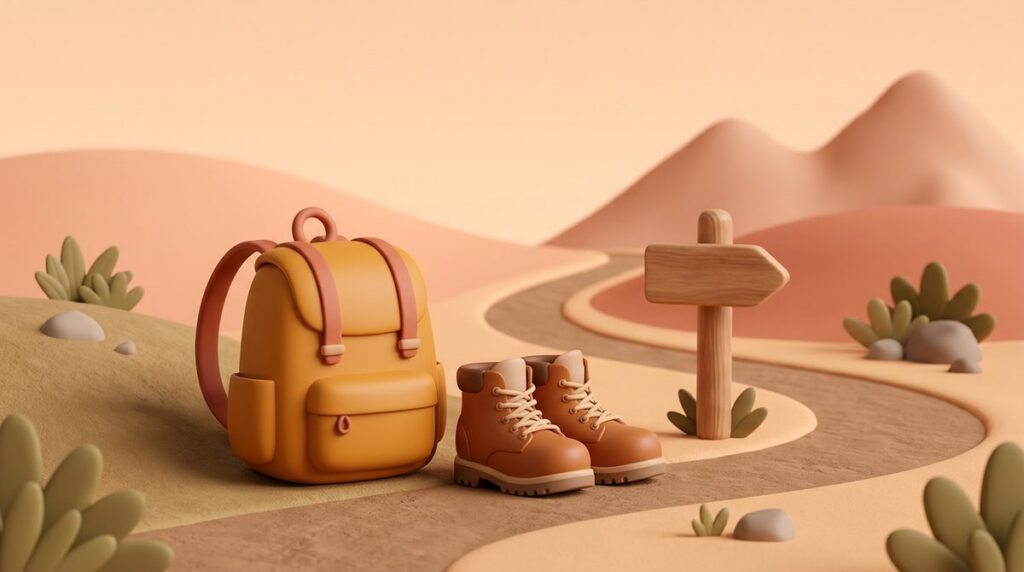
On the morning I left Saint-Jean-Pied-de-Port, a French Basque village at the foot of the Pyrenees, I weighed my backpack three times. 8.4 kilograms. By the standards of experienced pilgrims, this was too heavy. By the standards of someone who had never walked more than fifteen kilometers in a single day, it was terrifying. In front of me lay 800 kilometers of trail, thirty-three days of walking, and a destination — Santiago de Compostela — that I wasn’t entirely sure why I was heading toward.
I didn’t walk the Camino for religious reasons. I’m not Catholic. I’m not spiritual in any organized sense. I walked because a friend who’d done it the previous year said something that lodged in my brain: “You start walking to get somewhere. By day ten, you realize the walking IS the somewhere.” I didn’t understand what that meant. I needed to find out.
The Pyrenees: Day One Reality Check
The first day of the Camino Francés — the most popular of the Camino routes — crosses the Pyrenees from France into Spain. It’s 25 kilometers of continuous climbing followed by a knee-destroying descent into Roncesvalles. Guidebooks describe it as “challenging.” Veterans call it “the filter.” Many pilgrims arrive at the monastery in Roncesvalles that evening having already decided to quit.
I nearly did. By kilometer eighteen, both feet were bleeding through two layers of socks — blisters I’d been warned about but couldn’t have prepared for. My shoulders ached. My knees protested every downhill step. The romantic vision of myself as a contemplative pilgrim striding nobly across mountains was replaced by the reality of a sweating, limping, mildly panicked person wondering why they’d voluntarily chosen to do this instead of sitting on a beach somewhere.
But then: the descent into Spain. The Pyrenean beech forests gave way to a valley view so expansive that my discomfort momentarily disappeared. Rolling green hills, ancient villages, a river catching the afternoon light. And walking toward all of it, ahead of me on the trail, a line of pilgrims with packs on their backs and shells on their hats, looking exactly like the medieval illustrations I’d seen in guidebooks. Something clicked. Not enlightenment — just a recognition that I was now part of something that had been happening on this same path for over a thousand years. That continuity felt like belonging.
The Camino doesn’t ask you to believe anything. It just asks you to walk. Everything else — the reflection, the connection, the transformation — happens as a side effect of putting one foot in front of the other, day after day, for a month. -Sofia Martins
The Meseta: The Boring Part That Changes You
After the mountains and the green valleys of Navarra, the Camino enters the meseta — the vast central plateau of Spain. For approximately 200 kilometers, the trail crosses flat agricultural land with minimal shade, minimal variation, and minimal visual interest. The horizon is so distant it barely moves. Days blend together. Many pilgrims skip this section entirely, taking a bus to León.
Don’t skip it. The meseta is where the Camino does its real work.
Stripped of scenic distraction, you’re left with yourself — your thoughts, your footsteps, and the metronomic rhythm of walking that gradually quiets the mental chatter until something deeper emerges. I can’t describe what that “something” is without sounding like a wellness influencer, which is exactly what I’m trying to avoid. I’ll say this: after three days on the meseta, I stopped listening to podcasts, stopped planning my next Instagram post, and started having the kind of honest internal conversations that I’d been avoiding for years.
The walking rhythm helps. Five kilometers per hour, roughly 35,000 steps per day, produces a cadence that the brain synchronizes with. Neuroscience research suggests that bilateral rhythmic movement (walking, running, drumming) activates both hemispheres of the brain and facilitates emotional processing — it’s the same principle behind EMDR therapy. Whether or not that’s what was happening on the meseta, I processed grief, resentment, and anxiety that I’d been carrying for years, and I did it not through deliberate reflection but through the simple, mechanical act of walking in a straight line under a Spanish sun.
The People You Meet
Nobody walks the Camino alone. Even if you start solo, the trail’s social architecture ensures you’ll collect companions. The albergue system — communal hostels spaced a day’s walk apart — forces interaction. You eat together, sleep in shared rooms, nurse each other’s blisters, and form bonds with an intensity and speed that would be impossible in normal life.
- Hans, a retired German engineer walking to process his wife’s death. He moved slowly, methodically, and carried a watercolor set that he used to paint one small picture each evening. His paintings were terrible. His commitment was inspiring.
- Yuki, a Japanese university student who had never traveled alone before. She started the Camino so shy she could barely make eye contact. By week three, she was the social center of our walking group, organizing dinners and translating between the Japanese and Korean pilgrims.
- Marco, an Italian chef who cooked elaborate dinners in albergue kitchens using whatever ingredients the local shops provided. His ability to transform a can of chickpeas, some wilted spinach, and a lemon into a meal worth remembering was genuine artistry.
- Pilar, a Spanish grandmother walking her seventh Camino. She knew every hospitalero by name, every shortcut, every bar worth stopping at. She walked faster than people half her age and attributed her fitness to “wine, walking, and not worrying about things God hasn’t asked me to worry about.”
- David, a Canadian tech executive on indefinite leave. He’d sold his startup, made more money than he knew what to do with, and found himself unable to answer the question: “Now what?” The Camino, he said, was the first thing he’d done in years that couldn’t be optimized or measured by KPIs.

The Physical Reality
Let’s talk about feet. The Camino is a 800-kilometer conversation between your feet and the ground, and by day five, your feet have strong opinions. Blisters are not a possibility — they are a certainty. The question is how you manage them.
The pharmacies along the Camino are staffed by people who have seen ten thousand blistered feet and can assess and treat them in under three minutes. The standard treatment: drain with a sterilized needle, thread a piece of surgical thread through the blister (it acts as a wick, keeping the blister drained as you walk), cover with Compeed, and keep walking. It sounds medieval. It works.
Beyond blisters, the body adapts in remarkable ways. By week two, the daily 25-kilometer walk that had destroyed me on day one felt manageable. By week three, it felt natural. My body found a sustainable rhythm — a pace that I could maintain for seven hours without exhaustion. My appetite became enormous and perfectly calibrated; I ate when I was hungry, stopped when I was full, and burned everything I consumed. I lost fat and gained muscle without thinking about either.
The knees are the weak point. The cumulative impact of 800 kilometers of walking, much of it on hard surfaces, takes a toll that no amount of fitness can fully prevent. Trekking poles help enormously — they transfer roughly 25% of the load from your knees to your arms. I started without poles and bought them on day three. I cannot overstate their importance.
Santiago and the Paradox of Arrival
I arrived at the Cathedral of Santiago de Compostela on day thirty-three, at 11:42 AM, in light rain. The plaza was full of pilgrims — some kneeling, some crying, some standing in stunned silence, all wearing the same expression of confused achievement. We’d done it. We were here. And the overwhelming feeling, for me and for almost everyone I spoke to, was not triumph but a strange, tender sadness.
The sadness of arrival is the Camino’s final lesson. For thirty-three days, life had been simple: walk, eat, sleep, talk, repeat. Every day had a clear purpose and a clear direction — west. The complexity of normal life — its choices, its ambiguity, its lack of clear paths — had been replaced by a single yellow arrow pointing the way forward. Arriving at Santiago meant the arrows stopped. You had to choose your own direction again.
My friend was right. I started walking to get somewhere. Somewhere around day ten, I stopped caring about the destination and started paying attention to the walking itself — the rhythm, the landscape, the conversations, the silence, the pain, the beauty. The Camino doesn’t take you from Point A to Point B. It takes you from whoever you were when you started to someone slightly different at the end. Not better. Not healed. Not transformed. Just — slightly different. With better calves, worse feet, and a collection of friendships forged in sweat and shared suffering that no amount of social media connection could ever replicate.
If you’re thinking about walking the Camino, my advice is simple: go. Don’t plan too much. Don’t read too many blogs (including this one). Don’t set expectations. Just walk. The Camino will handle the rest. It’s been doing this for a thousand years. It knows what it’s doing better than you do.